K-0001
Base plate or flange with ribs on the end of a beam
Column base, flanged joint
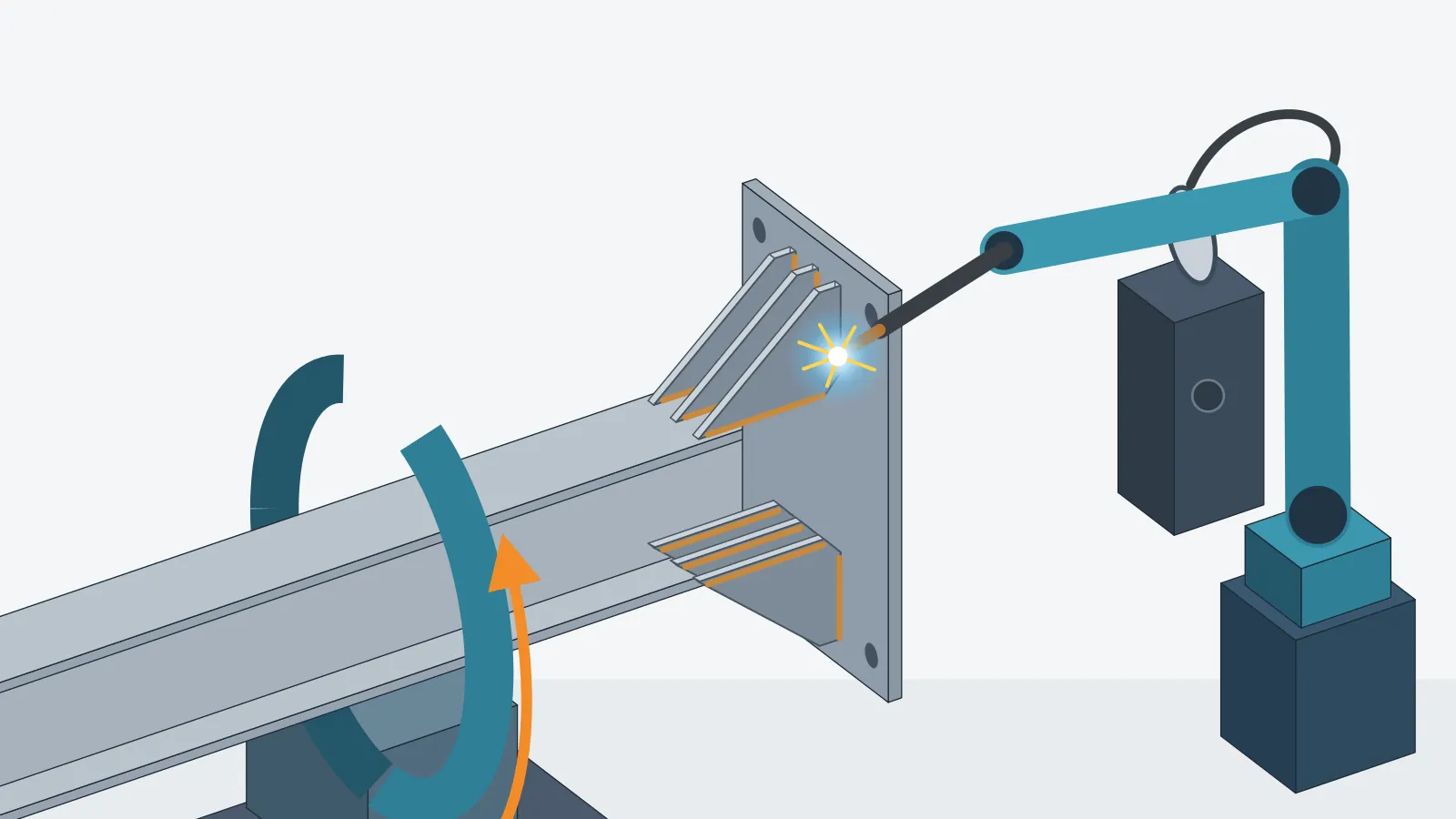
The job
Weld a base plate or a flange to the end of an I-beam (column, beam) or a pipe and stiffen it with ribs (gussets), and with traverses in heavy bases. By hand this means many short fillet welds in awkward positions. A robot with a positioner turns every weld into the flat position.
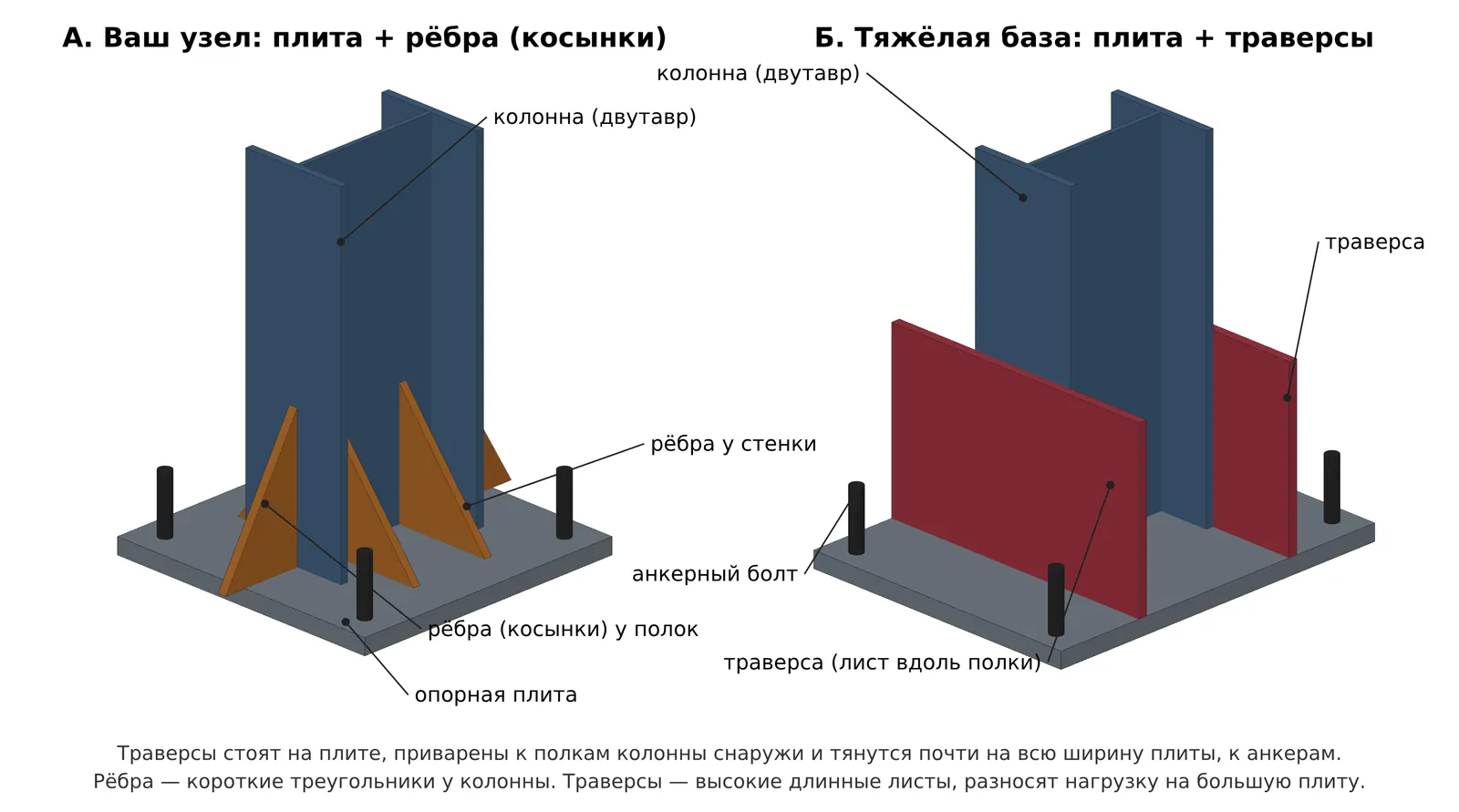
Terms: base plate · stiffening ribs, gussets (short triangles or trapezoids at the column) · traverses (tall plates along the flanges up to the anchors) · flange (end plate for bolts).
Part variants
- Base plate on the end: welds along the flanges and the web.
- Ribs, gussets or traverses between the plate and the beam: welds to the plate and to the flange or web.
- A flange instead of the plate: the same plus inside welds through the flange's through-hole.
Different sizes of the same joint belong to this case.
Layout
- The beam is clamped in a rotator, the end being welded is free.
- The robot stands still on the positioner's rotation axis, behind the beam end. No track is needed, an ordinary 6-axis robot with enough reach will do.
- Both sides stay free for options: automatic beam feeding on one side, a loading manipulator on the other.
- Loading and unloading from the side only. With the plate welded on, the beam cannot go back through a ring rotator, and the robot stands in front. So the rotator opens from the side (a jaw chuck or an open, split rotator), and a cross transfer or a crane takes the finished beam away.
- One end is welded, the other after the beam is turned around. Along the length or both ends at once: K-0002.
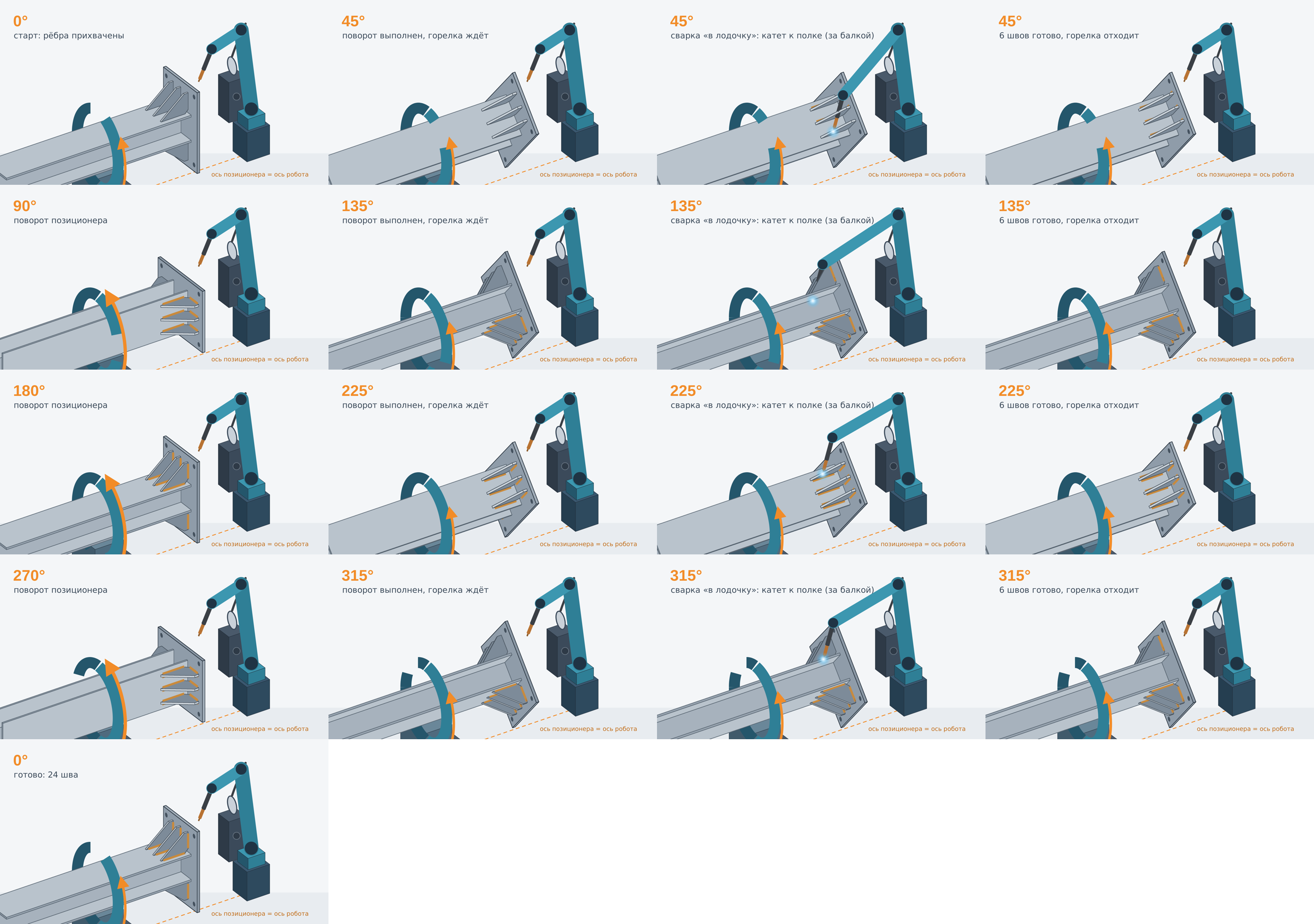
Process: 4 stops in the "boat" position
- The positioner turns the beam and stops at 45°, 135°, 225° and 315°.
- At each stop the ribs of one flange lie with one side in the "boat" position. The torch follows the bisector of the rib-to-flange angle, the robot makes 6 welds: 3 to the flange and 3 to the plate.
- 3 ribs per flange × 2 sides × 2 welds = 12 welds per flange, 24 per joint, in 4 stops.
- Turning around the beam axis does not put the rib-to-plate weld into PA, it stays in PB (horizontal fillet).
All frames of the cycle: pa-stops-grid.png.
Typical equipment
- Welding robot, 6 axes, MAG.
- A rotator positioner that opens from the side (jaw chuck or open, split rotator) and a fixture that clamps the plate or flange.
- Welding power source, wire feeder, torch.
Options
| Option | Side | What it gives | Effect on price and layout |
|---|---|---|---|
| Automatic beam feeding (cross conveyor, transfer with a roller table) | A | Beams go in and out from the side without a crane | Conveyor, sensors, automatic clamping |
| Light loading manipulator (~20 kg, magnetic gripper) | B | Places ribs and gussets, holds them for tacking | Robot, rib magazine, gripper |
| Heavy loading manipulator (50–150 kg) | B | Also places traverses and the plate or flange | More expensive; the plate is often easier to clamp in the fixture |
| Seam tracking (touch sensing, through-arc) | — | Tolerates inaccurate assembly | Controller option |
Welder qualification (Russia)
- Hazardous production facilities: NAKS certification (PB 03-273-99, RD 03-495-02).
- Ordinary construction: SP 70.13330, clause 10.1.3, requires confirmed welder qualification.
Who does this
| Integrator | What is shown | Link |
|---|---|---|
| Intellectual Robot Systems (IRS) | Cell for welding building structures, MT1-250 S2D positioner | irobs.by |
| Robot Union | Lighting poles, flange to pipe | case 1, case 2 |
| SMD | Lighting poles, positioner with a through-flange, inside weld | smd.com.ru |
| Robosvarka | Pipeline supports, Molot steel structures plant | robotosvarka.ru |